Atlantic Premiers Write Prime Minister Regarding the Atlantic Fisheries Fund

December 11, 2025

The Council of Atlantic Premiers has written to Prime Minister Carney regarding the future of the Atlantic Fisheries Fund (AFF).

Atlantic Premiers are concerned about the federal government’s plan to end the AFF on March 31, 2026. Premiers are calling on the Prime Minister to fulfill the election platform commitment to renew and enhance the AFF by increasing the fund by 20 per cent. 

-30-

To view the Letter to Prime Minister Carney: [link]
Council of Atlantic Premiers Releases Report on Preventing Domestic Homicides in Atlantic Canada

News Release

Council of Atlantic Premiers Releases Report on Preventing Domestic Homicides in Atlantic Canada 

The Council of Atlantic Premiers (CAP) has released a new report, Preventing Domestic Homicides in Atlantic Canada: Looking Back to See Our Way Forward, which provides a decade-long analysis of domestic homicides across the region and outlines opportunities for stronger prevention, data collection, and collaboration. 

The report was commissioned by the Atlantic Domestic Homicide Review Network (ADHRN), established by CAP in 2020 to strengthen regional efforts to prevent domestic homicide. The ADHRN brings together government officials from all four Atlantic provinces to share expertise, analyze data, and recommend system improvements that help save lives. 

“The loss of life due to domestic homicide is devastating for families and communities,” said New Brunswick Premier and CAP Chair Susan Holt. “By working together across the Atlantic region, we can better understand the factors that lead to these tragedies and take meaningful action to prevent them.” 

The ADHRN commissioned the Centre for the Study of Social and Legal Responses to Violence, led by Dr. Myrna Dawson at the University of Guelph, to conduct a 10-year retrospective study (2012–2022) on domestic homicides in Atlantic Canada. The project, which was funded by Women and Gender Equality Canada, began in April 2022 and concluded in August 2025. 

The study highlights both strengths and limitations in how information on domestic homicides is collected and analyzed across the region. It identifies 14 recommendations to enhance data collection, strengthen investigative processes, and improve service responses to those affected by gender-based violence. 

The report will help inform ADHRN’s ongoing activities and future work, including: 

  • Improving systemic responses and informing approaches to case reviews within each province; 
  • Promoting collaboration across government and with community partners, including individuals with lived experience; 
  • Increasing transparency and public confidence in domestic homicide reviews; and 
  • Expanding the evidence base on domestic homicide in the Atlantic region. 

Each Atlantic province will build on the report’s findings to strengthen prevention and response efforts. Jurisdictions will be expected to return to the Council of Atlantic Premiers in the fall of 2026 with a workplan outlining the next phase of the ADHRN’s work. 

The information included in the report addresses domestic homicide and may be difficult to read, particularly for the families of the victims of domestic homicide whose deaths were part of the research project, and for Atlantic Canadians experiencing gender-based violence. For support or information on available services, please visit Find family violence resources and services in your area – Canada.ca.  

Read the report here

-30-

Media Contacts: 

Atlantic Premiers Work to Unlock Region’s Potential

FOR IMMEDIATE RELEASE

(December 9, 2025) – Today, Premier Susan Holt of New Brunswick chaired a virtual meeting of the Council of Atlantic Premiers. She was joined by her colleagues Premier Tim Houston of Nova Scotia, Premier Rob Lantz of Prince Edward Island and Premier Tony Wakeham of Newfoundland and Labrador.

Atlantic Premiers agreed to invite Prime Minister Mark Carney to meet with them to advance an agenda to unlock Atlantic Canada’s potential as a leader in energy, defence, and critical minerals development.

As Premiers look to work with federal government to explore new economic opportunities, they also emphasized the need for the federal government to continue to support traditional industries that are critically important to the Atlantic Canadian economy.

Premiers are very concerned about the federal government ending the Atlantic Fisheries Fund (AFF) at the end of March 31, 2026.  They are calling on the Prime Minister to renew and enhance the AFF given their election platform commitment to increase the fund by 20 per cent. 

Since 2017, the four Atlantic provinces have contributed $126.5 million to the fund, supporting the federal contribution of $295 million.    The Atlantic contribution to the AFF is on top of the hundreds of millions of dollars the four provinces invest in this vital sector.

Premiers welcomed the recognition of a number of Atlantic proposals under the major projects initiative, including the federal recognition of the Sisson Mine in New Brunswick as well as Ottawa’s commitment to work with Nova Scotia on developing the Wind West offshore wind project. They also remain supportive of major projects proposed by Prince Edward Island to secure the Island’s energy future by modernizing its energy transmission and access to clean, affordable and reliable electricity, and Newfoundland and Labrador’s Bay du Nord offshore oil and gas project.

Premiers acknowledge that more must be done to realize the potential for further development encompassing all of Atlantic Canada.

The Atlantic region has significant potential for further energy generation, including hydroelectricity, onshore and offshore wind, oil, natural gas, solar and nuclear power. The region also contains significant untapped deposits of critical minerals that are essential for modern industry and technology.

To realize this potential, Atlantic Canada needs robust connections that link its electricity networks to one another, and to markets in other regions of Canada. With federal support the Region can ensure its critical mineral resources are developed at competitive prices for the global market which will drive further economic growth to the benefit of all Atlantic Canadians.

With the federal government’s renewed priority on strengthening Canada’s defense and protecting national sovereignty, Premiers noted that the Atlantic region is well-positioned to play a central role in achieving these objectives due to its strategic location, existing military infrastructure, and skilled workforce.

Premiers agreed to continue highlighting for the Prime Minister that Atlantic Canada is ready to contribute to these federal priorities.

Premiers discussed a range of other issues including the need for reliable cellular connectivity across the region for economic growth and for the health and safety of residents.

They also call on the Prime Minister to prioritize a settlement of the softwood lumber dispute with the United States as the most effective way to secure the future of the region’s lumber industry and the workers and communities that depend upon it.

Premiers discussed recent work by the Atlantic Domestic Homicide Review Committee and agreed on the importance of protecting women and children from all forms of domestic violence.

Premiers thanked Premier Holt for her work as chair of the Council over the past year. Premier Houston of Nova Scotia will assume the chair of the Council of Atlantic Premiers on January 1, 2026.

-30-

To view in PDF: CAP 39-C Communique, December 9, 2025

Eastern Canadian Premiers and New England Governors Meet in Newfoundland and Labrador to Strengthen Regional Partnership

Resolutions passed on technology and innovation, regional collaboration on energy, and ecological connectivity and food security

For Immediate Release

Monday, November 17, 2025

CONTACT

NL: Ashley Jackson-Politi, AshleyPoliti@gov.nl.ca, 709- 685-3161

VT: Amanda Wheeler, Amanda.Wheeler@vermont.gov

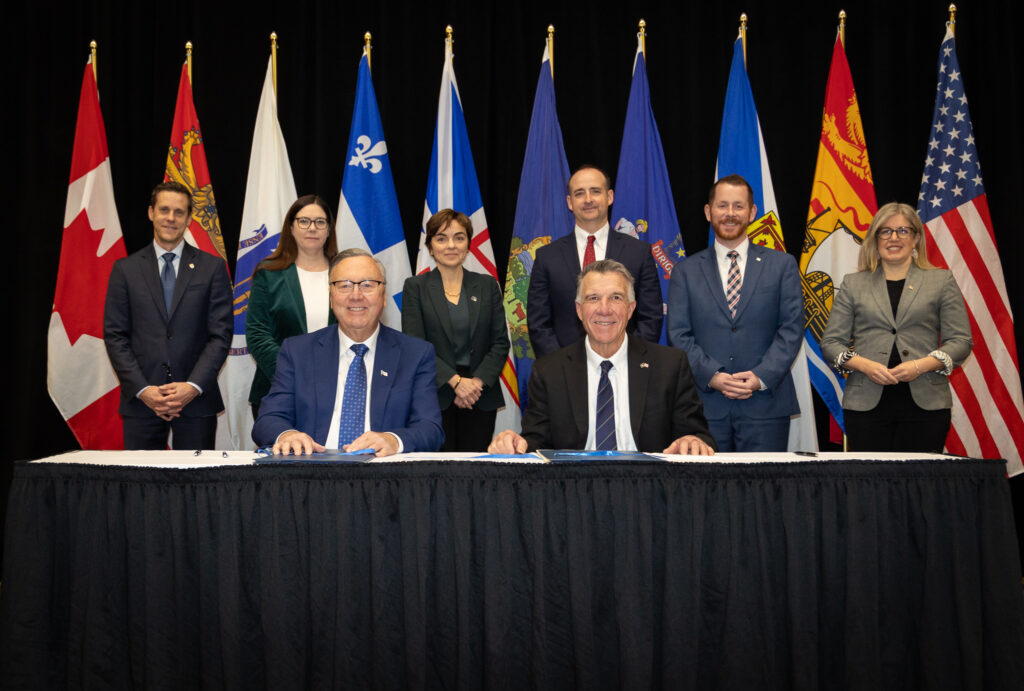
ST. JOHN’S, NL – New England Governors, Eastern Canadian Premiers, and their representatives met on November 16 and 17, 2025 in St. John’s, Newfoundland and Labrador at their 46th annual conference to discuss shared energy and environmental priorities, as well as opportunities to enhance regional collaboration in technology and innovation.

Following the reconvening of the Northeast International Committee on Energy and the Committee on Environment in 2024, both committees provided updates on work completed throughout 2025 to advance regional collaboration, planning on energy issues, ecological connectivity, and food security. These two standing committees have long served to pursue initiatives that the Governors and Premiers direct at the annual conference.

Three resolutions were adopted at the conference, including two directing the continuation of collaboration on energy, ecological connectivity, and food security. In addition, a resolution was adopted to initiate collaboration on technology and innovation. The resolutions are available here: 46-1, 46-2, 46-3.

Premiers, Governors, and appointed representatives also discussed other mutual priorities impacting citizens of their respective jurisdictions, including the cost of living and affordability concerns and the impact of trade relations on the economy on both sides of the border.

“It was an honour to co-chair and host this year’s New England Governors and Eastern Canadian Premiers conference in Newfoundland and Labrador, where we welcomed our regional partners,” said Newfoundland and Labrador Premier Tony Wakeham. “We focused our conversations on technology and innovation, energy, and environment, and demonstrated the collective strength of our jurisdictions and the value of working together.”

“From energy to innovative technology and environmental resilience, there’s a lot of good happening across the region on both sides of the border,” said Vermont Governor Phil Scott. “It’s important we continue to find ways to solve some of the challenges because the relationship between Canda and New England states is important and something we all need to continue to repair and strengthen.”

On November 16, delegates visited the Co. Innovation Centre for technology demonstrations from local innovators, including Avalon Holographics, College of the North Atlantic, Duxion Motors, Kraken Robotics, PolyUnity, and Virtual Marine. Premiers, Governors, and other delegation heads also had a fireside chat with attendees about the role of technology and innovation in growing our economy.

“Technology and innovation are key drivers of economic development and areas where Newfoundland and Labrador bring deep expertise and demonstrated leadership to the table,” said Meagan Kay-Fowlow, President of COIC. “I congratulate Premier Wakeham and his colleagues across Eastern Canada and New England for their vision and collaboration. It was a pleasure to host them this weekend.”

Delegates also participated in a tour of the Beaumont Hamel and Trail of the Caribou Exhibition at The Rooms.

Premier Wakeham co-chaired the conference with Governor Phil Scott of Vermont. Other Governors and Premiers and their representatives in attendance were: New Brunswick Premier Susan Holt, Prince Edward Island Premier Rob Lantz, Nova Scotia Minister of Growth and Development Colton LeBlanc, Quebec Minister of Economy, Innovation and Energy Christine Fréchette, Massachusetts Commissioner of the Department of Energy Resources Elizabeth Mahony, and Maine Acting Commissioner of the Department of Energy Resources Dan Burgess.

Quotes from Conference Participants:

New Brunswick Premier Susan Holt:

“This conference is a great reminder of what we can achieve when we work together across borders. From advancing clean energy to driving innovation and strengthening food security, our shared challenges are also shared opportunities. Collaboration like this helps us build a stronger, more sustainable future for everyone in our region.”

Prince Edward Island Premier Rob Lantz:

“Prince Edward Island values the strong partnerships we share with our New England and Eastern Canadian neighbours. Through continued collaboration, we can strengthen our economies and improve the quality of life on both sides of the border.”

Massachusetts Commissioner of the Department of Energy Resources Elizabeth Mahony:

“Massachusetts is proud to participate in the Annual Conference of New England Governors and Eastern Canadian Premiers,” said Massachusetts Energy Resources Commissioner Elizabeth Mahony. “It was a privilege to welcome our regional partners to Boston last year, and we extend our thanks to Newfoundland and Labrador for hosting this year’s discussions. Our relationship with Canada has never been more important — grounded in shared values, common interests, and deep familial ties. Massachusetts remains committed to strengthening this partnership to expand energy supply, meet rising demand, lower costs, create jobs, and advance economic growth throughout the region.”

Nova Scotia Minister of Growth and Development Colton LeBlanc:

“Nova Scotia has a lot to offer the Atlantic region and the Eastern United States, particularly when it comes to meeting the massive energy needs of our region. We’re pleased to collaborate on ideas and solutions that are in the best interest of hardworking Nova Scotians, and can help us grow and prosper.”

Quebec Minister of Economy, Innovation and Energy Christine Fréchette:

“Québec is a leader in green energy and its cutting-edge expertise is a key lever that is recognized around the world. This annual conference is a unique opportunity to strengthen our strategic ties with New England and Eastern Canada, particularly on issued related to energy supply and defence. In the current geopolitical climate, these issues are among our government’s top priorities. To achieve our goals, we must focus on close and lasting collaboration with our partners.”

Maine Acting Commissioner of the Department of Energy Resources Dan Burgess:

“Maine has long worked closely with our neighboring Canadian provinces and fellow New England states on a range of shared issues, and today these cross-border collaborations are more important than ever. Maine and Canada share more than a border – our economies are closely linked, our electricity grids are interconnected, and we each rely on significant cross-border energy trading. Through these convenings, we are advancing shared priorities and strengthening the regional systems and relationships needed to deliver affordable, reliable, and cleaner energy for Maine and the region.”

About the New England Governors and Eastern Canadian Premiers (NEG-ECP) Conference

Since 1973, the six New England states and the five Eastern Canadian provinces have worked cooperatively to address their shared interests across the border. Through the annual conferences of Governors and Premiers and discussions of joint committees, the NEG-ECP encourages cooperation by developing networks and relationships, taking collective action, engaging in regional projects, undertaking research, and increasing public awareness of shared interests.

The 11-member jurisdictions are Connecticut, Maine, Massachusetts, New Hampshire, Rhode Island, Vermont, New Brunswick, Newfoundland and Labrador, Nova Scotia, Prince Edward Island, and Québec.

###

Northeastern U.S. Governors and Canadian Premiers Reaffirm Partnership Committed to Trade, Economic Relations

For Immediate Release 

Northeastern Governors and Canadian Premiers convened in Boston today at the ‘Strong Partnerships, Shared Future Convening’ to discuss impacts of tariffs and opportunities for continued partnership

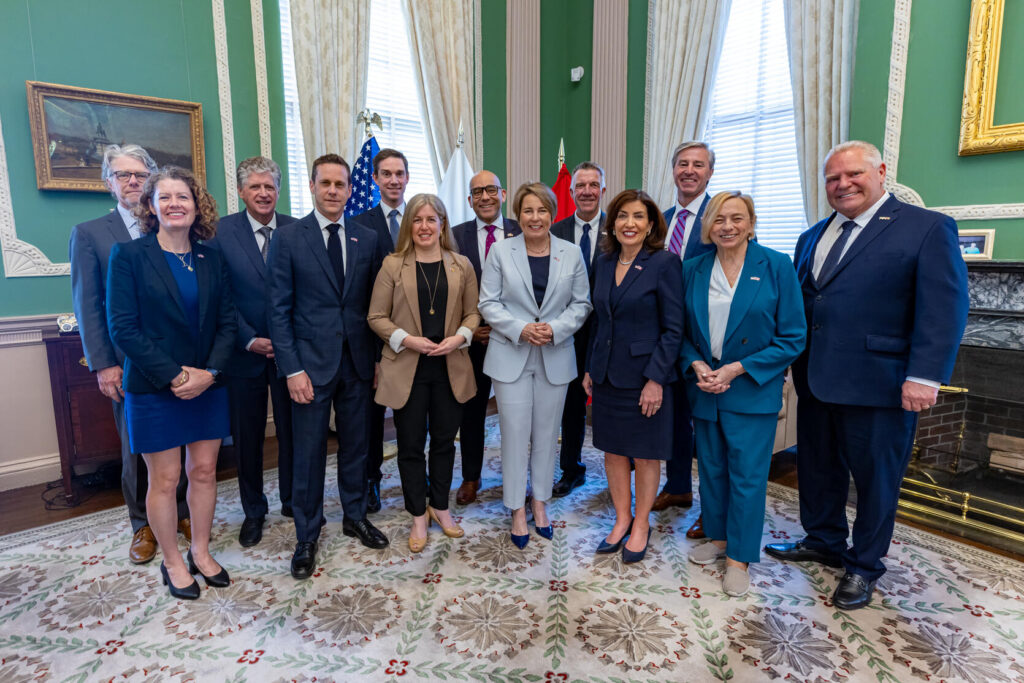
Boston — Today, northeastern U.S. Governors and Canadian Premiers gathered at the Massachusetts State House to discuss their commitment to strengthening trade and economic relations. Massachusetts Governor Maura Healey hosted the Strong Partnerships, Shared Future Convening in response to tariffs on Canadian imports and exports.

Those participating in the convening were: Massachusetts Governor Maura Healey, Maine Governor Janet Mills, New York Governor Kathy Hochul, Rhode Island Governor Dan McKee, Vermont Governor Phil Scott, Premier of Prince Edward Island Rob Lantz, Premier of Nova Scotia Tim Houston, Premier of Ontario Doug Ford, Premier of New Brunswick Susan Holt, Premier of Newfoundland and Labrador John Hogan, Québec Minister of the Economy and Minister Responsible for the Fight Against Racism Christopher Skeete (representing Premier François Legault), Connecticut Energy and Environmental Affairs Commissioner Katie Dykes (representing Governor Ned Lamont), and New Hampshire Department of Business and Economic Affairs Commissioner Taylor Caswell (representing Governor Kelly Ayotte).

“For centuries, the northeastern United States and Canadian provinces have been uniquely linked by our shared cultural, familial and economic ties. But this special partnership is facing an existential crisis like never before, threatening to sever these bonds, undermine our local economies, and raise costs for residents and businesses,” said Massachusetts Governor Maura Healey. “That is why I wanted to convene Governors and Premiers today – to send a clear message that we are going to continue to embrace these bonds and seek out opportunities for economic relations and trade. Our economies and our communities will be stronger because of the discussions we had today and our commitment to continued partnership between our two nations.”

During the convening, Governors and Premiers pointed to the centuries-old economic, familial and cultural bonds that connect northeastern American states and Canadian provinces. Canada and the United States enjoy the world’s most comprehensive trading relationship – Canada is the top trading partner for most states and the single largest foreign supplier of energy to the United States. The U.S. is the largest recipient country of Canadian direct investment, while the United States is the single greatest investor in Canada.

The Governors and Premiers expressed their desire to enhance economic ties, support existing robust trade and investment relationships, and work in partnership to promote greater understanding and friendship between the people of the two regions. The areas that they singled out for further collaboration are: trade and investment, tourism and hospitality, energy, manufacturing and supply chain resilience.

A recording of the discussion between Governors and Premiers moderated by former Vice Chair of Bank of America (BofA) and former Chair of BofA Europe Anne Finucane during the convening can be found here
 

Statements from Governors and Premiers

Governor Ned Lamont, Connecticut: 
“Connecticut has long shared a strong friendship and economic partnership with the eastern Canadian provinces — ties built on respect, trade, and a shared commitment to regional prosperity. From tourism to clean energy and innovation, our close collaboration has created meaningful opportunities for both sides of our border. We value this enduring relationship and look forward to deepening it in the years ahead.”

Governor Janet Mills, Maine: 
“The relationship between Canada and the United States — and Maine in particular — is defined by more than our deep economic and cultural ties — our cuisine, our shared language, our lumber, seafood, and agricultural heritage; it is rooted as well in the intertwined lives of generations of families, including my own, whose lineage and histories span both sides of the border. This convening reaffirms our longstanding friendship and sends the message that our relationship is stronger than the misguided rhetoric and actions coming from Washington. I am grateful to the Governors and Premiers who attended today in support of the historic friendship of our states and the sovereign country of Canada. The people of Maine and the nation stand with our friends in Canada.”

Premier Susan Holt, New Brunswick: 
“We have been good neighbours and trade partners for decades and we continue to treasure our long-standing friendship with northeastern states. New Brunswick provides essential energy, tourism and manufacturing to these states. During our meetings today, I stressed the importance of our economic and cultural ties to both our countries, while pitching opportunities to make our partnership even stronger.”

Premier John Hogan, KC, Newfoundland and Labrador: 
“Newfoundland and Labrador is rich in natural resources and abundant in clean, reliable energy. Working together, we can power prosperity on both sides of the border. By continuing our collaboration, we’re not just addressing today’s challenges — we’re shaping a future around common priorities that will make both economies stronger.”

Governor Kathy Hochul, New York: 
“We’ve said it from Day One: this misguided tariff policy is going to hurt New York’s economy. From the storefronts of Buffalo to the farms of the North Country, New York’s economic strength depends on trade with our neighbors to the north. We’re standing together to protect this $50 billion economic relationship and support working families.”

Premier Doug Ford, Ontario: 
“It’s never been more important for premiers and governors to work together to put an end to tariffs and bring certainty for workers, businesses and families. Together, let’s restore the pride of ‘Made in the U.S.A.’ and ‘Made in Canada’. Together, let’s build Fortress Am-Can, a renewed strategic alliance between America and Canada that’s a beacon of stability, security and long-term economic growth on both sides of the border.”

Premier Rob Lantz, Prince Edward Island: 
“Our province has a long history of trade with the northeastern United States. This meeting was an opportunity to speak directly to the pressures facing our exporters, highlight the importance of reducing barriers, and stand up for the sectors that drive growth and opportunity in our province.”

Minister for the Economy and Minister Responsible for the Fight Against Racism Christopher Skeete, Québec: 
“We believe there is a clear role for states and provinces to strengthen our relationship.  This convening of Northeast states and provinces highlights our shared interests, values, and the importance of ongoing regional collaboration at the sub-national level. We are glad to contribute to the dialogue between Canada and the United States which is also taking place at the federal level.”

Governor Dan McKee, Rhode Island: 
“As states face growing challenges brought on by tariffs, it’s critical that we come together to protect the jobs and industries that depend on strong, stable U.S.-Canada partnerships. Rhode Island values the long-standing economic and cultural ties we share with our Canadian neighbors. I appreciate Governor Healey’s leadership in convening us—because when we work together, we can support regional industries and keep our economy growing and competitive.”

Governor Phil Scott, Vermont: 
“Canada is an important trading partner to the United States and especially Vermont. As I’ve said before, I don’t believe increasing tariffs on them, in particular, was a good idea. It was great to meet with fellow Northeastern Governors and Eastern Canadian Premiers to discuss issues impacting all of us and continue to strengthen the relationship we have with our friends and allies to the north.” 

###

25 Years of Atlantic Collaboration

For Immediate Release 

HALIFAX, NS (May 15, 2025) – The following statement was issued today by the Council of Atlantic Premiers: 

“For the past 25 years, the Council of Atlantic Premiers has provided an invaluable forum to promote regional collaboration, strengthen the region’s economy and ensure that Atlantic Canada is fully represented in advancing Canada’s future. 

“The Council was established on May 15, 2000, through an agreement signed by the Premiers of New Brunswick, Nova Scotia, Prince Edward Island and Newfoundland and Labrador. The Council has built on the foundation of the Council of Maritime Premiers, created in 1971 to advance the region’s interests within the Canadian federation. 

“Over the past quarter-century, the Council has brought together the region’s Premiers to build a stronger regional partnership, put forward joint positions on national issues and explore ways to collaborate to improve services for Atlantic Canadians. Through its actions, the Council helps ensure that Atlantic Canadians have a voice in the decisions that shape the future of our country. 

“We look forward to a continued partnership among our provinces that advances a growing and resilient Atlantic region within a prosperous and united Canada.” 

-30- 

Media contacts: 

Katie Beers, Office of the Premier, New Brunswick, 506-230-0206 

Catherine Klimek, Office of the Premier, Nova Scotia, 902-717-1020 

Dean Lund, Office of the Premier, Prince Edward Island, 902-368-4400 

Sonja Pomeroy, Office of the Premier, Newfoundland and Labrador, 709-729-4304 

Atlantic Premiers head to Washington, D.C., to defend economic partnership

Atlantic Canada’s Premiers will travel to Washington, D.C., next week to highlight the significant value of our important trade relationship in meetings with U.S. political and business leaders.

New Brunswick Premier Susan Holt hosted a virtual meeting of the Council of Atlantic Premiers yesterday to discuss the upcoming mission and ways they can continue to work together to strengthen the region’s economy and mitigate the threat of an uncertain trade climate with the United States. She was joined by Premier Dennis King of Prince Edward Island and Premier Tim Houston of Nova Scotia.

Atlantic Premiers will be part of the Council of the Federation mission to Washington, D.C. on February 12, 2025. All 13 provincial and territorial leaders will be in the U.S. capital to directly demonstrate to American leaders the benefits of a stable North American economic partnership.

Premiers will emphasize the importance of Canada to the security of the United States, and the benefits that the continental economic partnership has brought to both countries. They will stress Atlantic Canada’s deep historical ties with New England and the northeastern U.S. states and the significant integration of their economies.

As the threat of U.S. tariffs is paused, but not removed, Premiers discussed ways they can collaborate to bolster the resilience of Atlantic Canada’s economy. Premiers will continue to urge Atlantic Canadians to support Canadian businesses and buy Canadian-made products whenever possible. They also pledged to continue working together to make Atlantic Canada a leader in the removal of barriers and irritants to trade and labour mobility within the Atlantic region and across Canada.

-30-

To view in PDF: CAP 39-A Communique – February 7, 2025

Atlantic Premiers Discuss Goals for 2025 and Celebrate Achievements of 2024

Atlantic Premiers met virtually today to discuss shared successes in 2024 while establishing a plan and priorities for further progress in 2025.
As Chair of the Council of Atlantic Premiers (CAP), Premier Dr. Andrew Furey of Newfoundland and Labrador was joined by Premier Susan Holt of New Brunswick and Premier Dennis King of Prince Edward Island. Premiers extended their appreciation to Premier Furey, the outgoing Chair, for his leadership and collaborative approach in 2024. Premier Holt will assume the CAP Chair in January 2025.

Atlantic Premiers achieved significant progress on key issues this year, such as healthcare collaboration and immigration, and continue to remain strong advocates of affordability. In response to the housing crisis, Premiers implemented record levels of supports and investments. They also successfully urged the federal government to review the carbon tax on home heating fuel and to return undistributed federal carbon tax revenue to small and medium-sized businesses. Additionally, Regional Air Access remains a priority, and work is underway on the Atlantic Wildfire Centre, which will enhance the region’s resilience and preparedness for wildfire response. These efforts have made a tangible difference in the lives of Atlantic Canadians and lay the groundwork for further progress in the future.

Premiers emphasized the importance of Atlantic Canada’s relationship with the United States and reaffirmed their commitment to a Team Canada approach in collaborating with our longtime ally and partner. They also noted the long and productive history of collaboration between the Atlantic provinces and the New England states on many shared priorities, including through the collaborative New England Governors – Eastern Canadian Premiers (NEG-ECP) forum. Newfoundland and Labrador, as Chair of the NEG-ECP, will host the group’s annual conference in 2025. New Brunswick will also host the annual Southeastern United States–Canadian Provinces (SEUS–CP) conference in June 2025.

Newfoundland and Labrador has called for an urgent meeting of NEG-ECP premiers and governors to safeguard the robust and interconnected relationship the New England-Eastern Canadian region shares. Looking forward, Atlantic Premiers will continue to collaborate to advance shared priorities, including renewable resource development, immigration and population growth, the transition to a greener economy, energy, health care, food security, affordability and direct engagement with our valued trading partners in the United States.

-30-

To view in PDF: CAP 38-C Communique December 9, 2024

In Massachusetts, New England Governors and Eastern Canadian Premiers Commit to Continued Cross-Border Collaboration

Governors and Premiers pass resolutions to reconvene standing committees on energy and the environment

BOSTON — The New England Governors and Eastern Canadian Premiers (NEG-ECP) met to discuss coordinated efforts on shared economic, energy and environmental priorities at the 45th annual NEG-ECP Conference held on September 9 and 10 in Boston, Massachusetts. Discussions built on last year’s conference in Québec City, the first in-person meeting of the NEG-ECP since 2018.

The clean energy transition was the primary topic of discussion, with a focus on achieving broad regional economic and reliability benefits, energy independence, and job growth. The leaders held two formal discussions on developing a regional offshore wind supply chain and strategies for hard-to-decarbonize sectors. Through two resolutions, the Governors and Premiers agreed to reconvene the Northeast International Committee on Energy (NICE) to pursue regional collaboration and planning on these and other energy issues, as well as direct the Committee on Environment to reconvene and consider further steps on ecological connectivity, climate adaptation and food security.  These two standing committees of the NEG-ECP have long served as vehicles for pursuing initiatives that the Governors and Premiers direct at the annual conference. The resolutions are available here: 45-1, 45-2.

“Last year’s conference was an important milestone in the long-standing collaboration between our regions, marking the 50th anniversary of these cross-border meetings. We were proud to welcome our colleagues to Massachusetts to spark the beginning of our next 50 years of cooperative work together,” said Massachusetts Governor Maura Healey. “We’re excited to continue our work together to achieve greater energy independence and affordability, create new union jobs and build up the climate workforce, and take proactive steps to address climate change.”

“As the easternmost province in Canada, advantageously located close to the European market as well as the United States, Newfoundland and Labrador has long recognized the value of working collaboratively towards shared goals,” said Newfoundland and Labrador Premier Dr. Andrew Furey. “Our discussions at this year’s NEG-ECP further strengthen our commitment to the clean energy transition and our trade relationship. I look forward to hosting the conference next year.”

Governor Healey co-chaired the 45th NEG-ECP meeting with Premier Andrew Furey of Newfoundland and Labrador. Other Governors and Premiers and their representatives participating in the meeting were: Governor Ned Lamont of Connecticut; Governor Janet Mills of Maine; Governor Daniel McKee of Rhode Island; Governor Phil Scott of Vermont; Premier Dennis King of Prince Edward Island; Minister of International Relations and La Francophonie Martine Biron of Québec; Associate Deputy Minister of the Office of Priorities and Planning Dave MacGregor of Nova Scotia; and Executive Director of Department of Intergovernmental Affairs Serge Breau of New Brunswick.

On Monday, the Governors and Premiers visited the Massachusetts Maritime Academy, where they experienced the Mærsk Mc-Kinney Møller Bridge Simulator and toured the cutting-edge facility training the workforce for maritime fields, including the offshore wind industry. On Tuesday, the group spent the day at the Boston University Center for Data and Computing Science for a series of roundtables on offshore wind supply chain and addressing hard-to-decarbonize sectors. The Center is the school’s most sustainable and energy-efficient building to date and the largest building in Boston not reliant on fossil fuels, using closed-loop geothermal wells that provide heating and cooling, as well as electric appliances for cooking.

Quotes from Conference Participants:

Governor Ned Lamont, Connecticut:
“The northeast faces many challenges when it comes to energy affordability and reliability, and collaborating on these policies among our states and provinces is a way that we can work to diversify energy supplies, strengthen the clean energy supply chain, and grow the clean energy workforce. I appreciate Governor Healey for organizing this meeting and thank the New England governors and eastern Canadian premiers for their collaboration.”

Governor Janet Mills, Maine:
“Maine has a long and productive history of working closely with our neighboring Canadian provinces and fellow New England states on a variety of shared issues, from our economies to our environment. I am proud to continue that longstanding tradition of cross-border collaboration through this year’s NEG-ECP Conference. Through these regional partnerships, we will advance our shared vision of harnessing clean, renewable energy to enhance our energy independence, improve affordability, and create strong, good-paying jobs in rewarding careers – all of which will have the tremendous benefit of strengthening our economy and battling the climate crisis.”

Governor Phil Scott, Vermont:
“A strong relationship across our region is essential to the strength of our states and provinces – from the economy and energy to workforce and infrastructure – and these meetings are important to continuing to build on these connections. By sharing ideas and collaborating on shared priorities, we each bring back new opportunities and approaches to improving the lives of our residents, and our entire region.”

Governor Dan McKee, Rhode Island:
“Rhode Island is dedicated to collaborating with neighboring states and provinces to drive the clean energy transition forward, which is essential for our economic growth and environmental stewardship. By focusing on regional offshore wind initiatives and innovative strategies for hard-to-decarbonize sectors, we are not only enhancing energy independence but also creating valuable, good-paying job opportunities. A cleaner, greener tomorrow starts today, and I’m proud to partner with fellow New England governors and Canadian leaders to reaffirm our commitment to achieving that future.”

Premier Dennis King, Prince Edward Island:
“The connection between the New England states and Eastern Canada is one build on shared history, economic collaboration, cultural bonds, and working together as a region in times of need.  As a region, we will continue to strengthen this partnership, creating opportunities that benefit residents on both sides of the border.”

Martine Biron, Minister of International Relations and La Francophonie and Minister Responsible for the Status of Women, Quebec:
[English] “By participating in this important conference, Québec is strengthening its collaboration in New England and is delighted to be a partner in the transition to a green economy in North America. Collaboration between the region’s governments in developing renewable energies, decarbonizing the economy and combatting climate change is essential to achieving our common goals. The entire region can count on Québec and its diplomatic network as a reliable partner in making this necessary transition a success.”

[French] « En participant à cette importante conférence, le Québec renforce sa collaboration en Nouvelle-Angleterre et se réjouit d’être un partenaire de la transition vers l’économie verte en Amérique du Nord. La collaboration entre les gouvernements de la région en matière de développement des énergies renouvelables, de décarbonation de l’économie et de lutte contre les changements climatiques est essentielle pour atteindre nos objectifs communs. Toute la région peut compter sur le Québec et son réseau diplomatique comme partenaire fiable vers la réussite de cette nécessaire transition. »

Rear Admiral Francis X. McDonald, President, Massachusetts Maritime Academy:
“We are honored to host the New England Governors and Eastern Canadian Premiers as they continue their vital cross-border collaboration on energy and environmental initiatives. This gathering highlights the importance of regional cooperation, and it’s an incredible opportunity to showcase the Academy’s leadership in offshore wind, clean energy, and workforce development. Our commitment to these areas aligns perfectly with the resolutions passed today, and we are proud to support such forward-thinking action.”

Massachusetts AFL-CIO President Chrissy Lynch:
“Massachusetts has the strongest labor force ready to tackle the clean energy transition head-on. Cross-border partnerships are key to ensuring workers are at the center of driving this industry – trained, protected, and empowered. We’re not just meeting the challenge but setting the standard and ensuring our workers lead the way in building a sustainable future.”

Massachusetts Building Trades Unions President Frank Callahan:
“Labor is at the heart of the clean energy transition, and our skilled tradespeople are essential in building the infrastructure needed to reach Massachusetts’ goals. Union construction careers are pivotal in the effort, offering high-quality, well-trained professionals who are dedicated to excellence. Cross-border partnerships like this one are crucial, as they unite our expertise and resources, driving innovation and ensuring the climate goals are met together.”

About the ECP-NEG Conference

Since 1973, the six New England states and the five Eastern Canadian provinces have worked cooperatively to address their shared interests across the border. Through the annual conferences of governors and premiers and discussions of joint committees, the NEG-ECP encourages cooperation by developing networks and relationships, taking collective action, engaging in regional projects, undertaking research, and increasing public awareness of shared interests.

The 11-member jurisdictions of NEG-ECP are Connecticut, Maine, Massachusetts, New Hampshire, Rhode Island, Vermont, New Brunswick, Newfoundland and Labrador, Nova Scotia, Prince Edward Island, and Québec.

###

To view PDF: NEG-ECP Press Release September 2024, Boston, MA EN
To view Resolution 45-1 PDF: 45-1
To view Resolution 45-2 PDF: 45-2

Driving Progress: Atlantic Premiers Focus on Affordability, Housing, Health Care and the Economy

Atlantic Premiers met virtually today to discuss shared priorities and progress on collaborative work in areas of importance to Atlantic Canadians. This includes initiatives to improve affordability, housing, and health care, along with opportunities to address labour shortages and strengthen the region’s economy.


As Chair of the Council of Atlantic Premiers, Premier of Newfoundland and Labrador Dr. Andrew Furey was joined by Premier Tim Houston of Nova Scotia, Premier Dennis King of Prince Edward Island, and Premier Blaine Higgs of New Brunswick.


Premiers reiterated their commitment to support Atlantic Canadians, and indeed all Canadians, as wildfire season intensifies, including those affected by the ongoing fires near Churchill Falls, Newfoundland and Labrador, who remain under evacuation order. Premiers also discussed forest management best practices as well as the establishment of a Regional Centre of Excellence, located in central Newfoundland and Labrador, for training in fire preparedness and response. These efforts seek to improve the region’s resilience and readiness for present and future challenges by strengthening communities’ ability to manage forests sustainably and respond effectively to wildfires.  Premiers discussed pilots underway to improve cell service during emergency situations.  They urge the federal government to expand this initiative to all Atlantic Canada.


Affordability and Housing
Atlantic provinces are all making unprecedented investments to address the pressing issue of affordability, including the availability and rising costs of housing and shelter. Premiers shared their experiences and best practices in launching a variety of initiatives, including low-interest loans for the development of affordable rental properties, assistance for first-time homeowners, and in-law suites. Premiers recognize that access to housing remains a challenge and is crucial to growing vibrant communities.


Premiers underlined their commitment to continue their work together and with key partners to expand housing supply and access to affordable housing options as rapidly and responsibly as possible. This includes continuing to work with the federal government to ensure that housing investments are maximized for Atlantic Canadians and done in a manner that is sustainable for the future.


Health Care Collaboration
Through the Atlantic Health Accord, the Atlantic Provinces work together to improve patient-centered healthcare access, system efficiency, and patient outcomes.


Premiers have joined forces to help build a stable and sustainable healthcare workforce in Atlantic Canada. Committed to sharing resources and expertise, Atlantic Premiers, through the Atlantic Working Group on International Recruitment, are collaborating to help alleviate healthcare worker shortages and improve healthcare access in underserved areas.


Labour Market and Productivity
All provinces and territories are feeling the impacts of labour shortages, which are slowing economic growth, productivity, and innovation. In Atlantic Canada, these shortages are especially acute in the health care, construction, and service sectors. Federal Budget 2024 brought an unexpected reduction of $625 million in workforce development programs that help people find and maintain jobs in sectors facing critical labour shortages such as construction, early learning childcare, and healthcare. These Labour Market Transfer Agreements (LMTAs) support persons with disabilities, Indigenous peoples, women and newcomers, helping them to get the training and supports necessary to secure meaningful work, while also assisting employers to meet their labour demands.


With this cut, LMTA funding will revert to pre-2017 levels at a time when inflationary costs continue to have profound impacts on citizens. Provinces and territories were not notified of this cut prior to the release of the Budget on April 16, 2024. Premiers noted the negative impact the funding cut will have on the 120,000 individuals and 8,500 employers and organizations that have benefitted annually from these programs throughout Atlantic Canada. Premiers urged the federal government to immediately reverse these cuts to Labour Market Transfer Agreements.


Infrastructure, Economic Growth and Competitiveness
Atlantic Premiers discussed the critical infrastructure needed to power economic development in the region, including infrastructure that supports resilient and reliable supply chains, transportation and communications networks, energy distribution, and community development. Premiers noted the federal government has yet to announce an adequate successor to the Investing in Canada Infrastructure Program, which is now closed. Without dedicated support for the full range of infrastructure needs and the program flexibility to address the region’s unique requirements, Atlantic Canada’s economic growth and community development will be hampered.


Investing in well-functioning trade corridors improves the flow of people and goods in Atlantic Canada and helps Atlantic Canadians compete in key global markets, trade more efficiently with international partners, and keeps the region’s supply chains competitive and resilient. As a business and leisure destination, Atlantic Canada needs a strong and reliable domestic and international air service network to support economic growth, tourism and competitiveness. Atlantic Premiers are working together to identify gaps and ways to improve air linkages within the region.


The Chignecto Isthmus, which joins New Brunswick and Nova Scotia, contains the only road, rail, and telecommunications connection between the two provinces, and between Nova Scotia and the rest of Canada. Approximately $35 billion in goods and services moves through the isthmus every year. Collaboration with and support from the federal government is vital to protect this critical economic trade link, which faces increasing threats from more frequent and severe weather events.


-30-


To view in PDF: CAP 38-B Communique – June 25, 2024 EN

Atlantic Premiers Write Federal Ministers Regarding Carbon Tax Rebates for SMEs

The Council of Atlantic Premiers recently wrote to the Honourable Chrystia Freeland, Deputy Prime Minister and Minister of Finance, and the Honourable Rechie Valdez, Minister of Small Business, regarding the billions of carbon tax rebates overdue to Canadian small and medium-sized enterprises (SMEs).


Atlantic Premiers are concerned about the federal government’s approach to managing carbon tax rebates for businesses in the region, recognizing the unique challenges faced by SMEs operating in the Atlantic provinces. To find a resolution that supports impacted businesses, Premiers urged the Ministers to take immediate action to both ensure the prompt return of the overdue carbon tax revenues to businesses in the Atlantic provinces and to establish a transparent and efficient mechanism for annual distribution going forward.


-30-


To view the Letter to Ministers Freeland and Valdez: Letter to Ministers Freeland and Valdez


For media inquiries, please contact:
Adam Ross, Office of the Premier, Prince Edward Island, 902-368-4400
Catherine Klimek, Office of the Premier, Nova Scotia, 902-717-1020
Nicolle Carlin, Office of the Premier, New Brunswick, 506-453-7494
Meghan McCabe, Office of the Premier, Newfoundland and Labrador, 709-729-3960